
Fashion Industry · Sustainability · Consumer Behaviour
Why Clothing Waste Is Increasing in Online Fashion (2026)
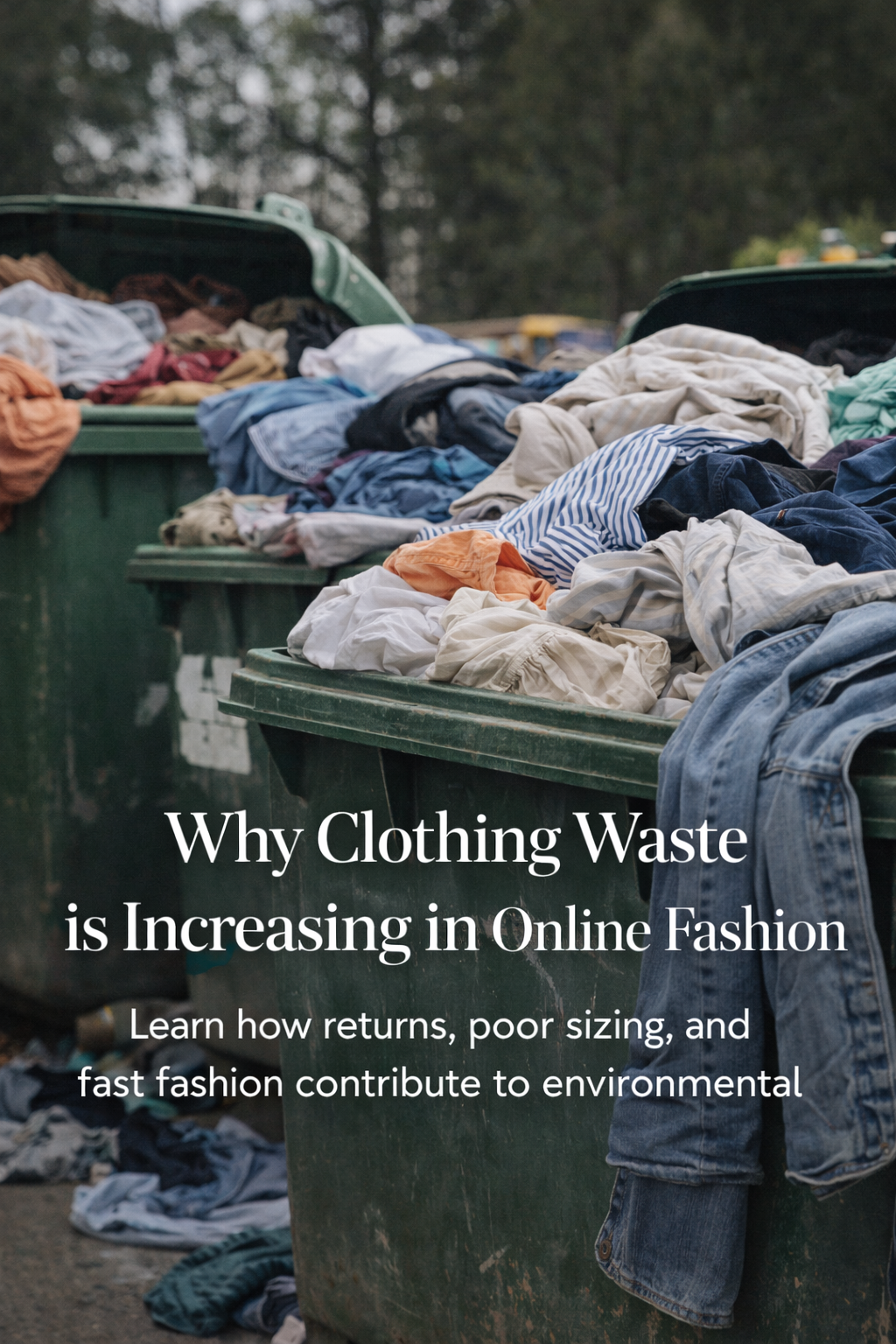
Clothing waste is not caused by a single problem. It is the result of several connected parts of the fashion system — including production volumes, short trend cycles, premature disposal, garment durability, sizing uncertainty and the logistics involved in online returns.
Quick Answer
Why is clothing waste increasing?
Clothing waste increases when garments are produced faster than they are meaningfully used, when products are discarded before the end of their useful life, and when inefficient purchasing, sizing and return behaviour adds unnecessary movement and handling to the supply chain.
- High production volumes can create excess inventory.
- Short trend cycles can encourage premature replacement.
- Poor fit information can increase online returns.
- Lower durability can shorten the useful life of garments.
- Better care, repair, reuse and purchasing decisions can extend garment life.
1. What Is Clothing Waste?
Clothing waste refers to garments and textile products that are discarded, damaged, unused, unsold or otherwise removed from active use. Waste can occur at different stages of the fashion lifecycle — from manufacturing and inventory management to consumer use and disposal.
This means the conversation about fashion waste is broader than what happens when a consumer throws away an old T-shirt. It also includes unused inventory, production inefficiencies, returns, damaged products and garments that are used only a small number of times.
2. Why Is Clothing Waste Increasing?
Modern fashion operates at a much faster pace than previous clothing cycles. New products can move from design to consumer markets quickly, while digital platforms make it easier to discover, compare and purchase new garments.
The result is a system where production, purchasing and disposal can happen more frequently. When garments are bought but rarely worn, replaced quickly or returned unnecessarily, their resources and logistics have been used without achieving a long useful life.
3. How Online Fashion Returns Affect Waste
Online clothing purchases introduce an important challenge: customers cannot physically try on a garment before buying it. Measurements, photography, fabric behaviour and fit descriptions therefore become critical parts of the purchasing decision.
When a garment is returned, the item may require additional transportation, packaging, inspection, cleaning, repacking and inventory handling before it can be sold again.
A return is not automatically waste. Its environmental impact depends heavily on whether the product can be efficiently processed and returned to active inventory.
- Additional transportation may be required.
- Additional packaging and handling may be required.
- Returned inventory may require inspection before resale.
- Poorly managed returns can create additional operational waste.
4. What Is Bracketing in Online Fashion?
Bracketing is a shopping behaviour in which a customer orders multiple sizes or versions of the same product with the expectation of returning the options that do not fit.
For example, a customer uncertain between M and L might order both sizes and return one. The customer may get a better fit, but the supply chain has handled two garments rather than one.
Better product measurements, clearer fit descriptions and useful size guides can reduce some of this uncertainty.
5. Why Online Clothing Sizing Matters
Clothing sizes such as S, M, L and XL are not universal measurements. Two brands can use the same size label while producing significantly different chest widths, garment lengths, shoulder dimensions and silhouettes.
This becomes particularly important with oversized clothing. An oversized T-shirt is intentionally wider and more relaxed, meaning choosing a size based only on the label can produce a very different result from what the customer expects.
Better way to choose a size
- Measure a T-shirt you already own.
- Compare chest and length measurements.
- Check whether the new garment is regular, relaxed or oversized.
- Consider fabric weight and construction.
Learn more: How to Choose the Right Clothing Size Online
6. How Garment Quality Affects Clothing Waste
Durability matters because a garment that remains functional and visually acceptable for longer can potentially stay in a customer's wardrobe for longer.
Fabric weight, yarn quality, stitching, seam construction, neckline recovery and finishing can all influence how a garment performs over time. However, fabric weight alone does not define quality.
A well-designed garment combines appropriate materials with suitable construction, fit and finishing.
Read our technical guide: What Is a Heavyweight Cotton T-Shirt?
7. Does Buying Better Quality Reduce Fashion Waste?
Buying better quality can help when it results in garments being worn more frequently and kept for longer. But quality alone is not a complete sustainability solution.
A durable garment that is rarely worn can still represent inefficient consumption. The more important question is whether the garment provides enough utility to justify its materials, production and logistics.
A better purchasing question:
"Will I wear this garment repeatedly over a long period of time?" is often a more useful question than simply asking whether the garment is expensive or inexpensive.
8. How Consumers Can Reduce Clothing Waste
Consumers do not need to completely change their wardrobes to reduce clothing waste. Small decisions throughout the garment lifecycle can make clothing more useful for longer.
- Buy garments you expect to wear repeatedly.
- Check garment measurements before ordering online.
- Avoid ordering multiple sizes unless genuinely necessary.
- Follow washing and care instructions.
- Repair minor damage when practical.
- Reuse or donate wearable garments instead of immediately discarding them.
- Choose versatile pieces that work across multiple outfits.
Continue Reading
PRAUXE Journal
Build a wardrobe you actually use.
Explore considered silhouettes, heavyweight essentials and modern everyday pieces designed around fit, construction and long-term wear.
Explore CollectionFrequently Asked Questions
Why is clothing waste increasing?
Clothing waste is influenced by high production volumes, short trend cycles, premature disposal, lower garment durability and online purchasing behaviours such as unnecessary returns.
How do online clothing returns contribute to waste?
Returns can require additional transportation, packaging, inspection and inventory handling. The actual impact depends on what happens to the returned product and whether it can be efficiently resold.
What is bracketing in online fashion?
Bracketing is ordering multiple sizes or versions of a product with the intention of keeping one and returning the others.
How can I reduce clothing waste?
Buy intentionally, choose the correct size, follow care instructions, repair garments when practical and keep clothing in use for as long as possible.
Does better clothing quality reduce waste?
Durable clothing can remain useful for longer and may reduce replacement frequency. However, longevity also depends on how frequently a garment is worn, maintained, repaired and reused.
Conclusion: The Future of Fashion Waste
Clothing waste is a complex problem involving production, purchasing behaviour, fit, returns, garment durability and end-of-life decisions. There is no single material or business model that solves the entire problem.
For consumers, one of the most practical approaches is to buy with greater intention: choose garments that fit correctly, suit your wardrobe, receive regular use and can be maintained over time.
Better fashion is not simply about buying more expensive clothing. It is about making each garment earn its place in the wardrobe.